
〈Clinical Trial〉Completion Report
We are pleased to report the completion of the specified clinical trial titled “Specified Clinical Trial on the Efficacy and Safety of a Novel Fecal Microbiota Transplantation Method for Autism Spectrum Disorder,” which was initiated by our research group in May 2023.
This specified clinical trial is published on the jRCT (Japan Registry of Clinical Trials) system.
https://jrct.mhlw.go.jp/latest-detail/jRCTs031230041
Details regarding the initiation of the specified clinical trial are described in the following article:
In addition, a paper on this specific clinical study,
We are pleased to announce that the article was published in the international academic journal *Frontiers in Pediatrics* on March 11, 2026.
Paper Publication Page (English): https://www.frontiersin.org/journals/pediatrics/articles/10.3389/fped.2026.1767346/full
Source:
Front. Pediatr. (2026) 14:1767346. doi: 10.3389/fped.2026.1767346
A booklet concerning the specified clinical trial is available on the following page:

Summary of Clinical Trial Results
◾️ 1. Date of Observation Period Completion
May 14, 2024
◾️ 2. Number of Enrolled Cases
31
◾️ 3. Background Information of Study Subjects
| Category | ASD children (n=31) 1) |
| Sex | |
| Male | 23 1) |
| Female | 8 |
| Age (years, mean±S.E.M.) | 8.06±0.41 |
| 5-6 | 10 |
| 7-8 | 9 1) |
| 9-10 | 7 |
| 11-12 | 5 |
| BMI (mean±S.E.M.) | 15.90±0.36 |
| Severity of Autism Spectrum Disorder | n (%) 2) |
| Normal | 1 (3.2) 3) |
| Moderate | 2 (6.5) 1) |
| Severe | 28 (90.3) |
1) One case was discontinued midway due to the subject’s circumstances, resulting in 30 study subjects.
2) Subjects diagnosed with ASD by pediatric neurologists and others in accordance with the inclusion criteria were classified using the SRS-2.
3) Among the study subjects, one was in the normal range based on the SRS-2 assessment.
◾️ 4. Information on Progress According to the Clinical Trial Design
Study Design
Pre-post comparative study (Before-after trial)
Subject Selection Process
① Screened children: 61
② Children who did not meet the inclusion criteria: 30
(Reasons: Age, treatment for other diseases, inability to visit the hospital, difficulty in obtaining a medical certificate)
③ Number of study subjects during the study period
At the start of administration: 31
At the end of administration (6 weeks): 31
At the observation period: 30
④ Number of dropouts and reasons
Number of dropouts: 1
Reason for dropout: Continuation became difficult due to the guardian’s circumstances.
◾️ 5. Summary of the Occurrence of Adverse Events (Diseases, etc.)
In the 30 study subjects, no adverse events, including minor ones, were observed.
◾️ 6. Data Analysis and Results of Primary and Secondary Endpoints
For the 30 study subjects, the mitigating effects of the novel FMT method on ASD and its associated symptoms were evaluated using the following endpoints. Statistical analysis was performed using the Paired T-test or Wilcoxon signed-rank test.
Primary Endpoint
① SRS-2 (Social Responsiveness Scale, Second Edition)
At 30 weeks post-FMT, the severity of ASD was statistically significantly reduced by approximately 29% (P<0.001).
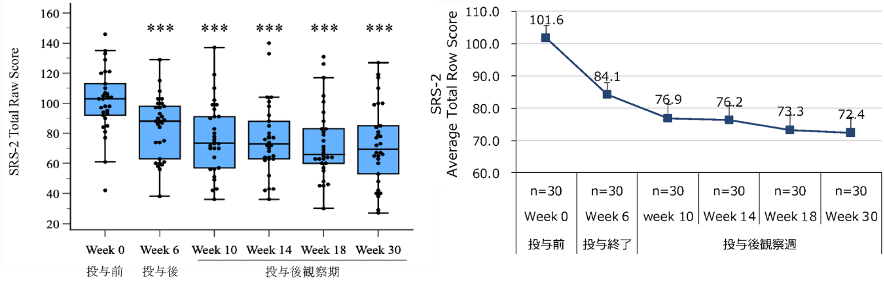
<(Left figure) Box plot of SRS-2 total score. Paired T-test or Wilcoxon signed-rank test (Post-FMT vs Pre-FMT); ***p<0.001.
(Right figure) Transition of the mean value of SRS-2 total score. Each data point represents the mean ±S.E.M of n=30.
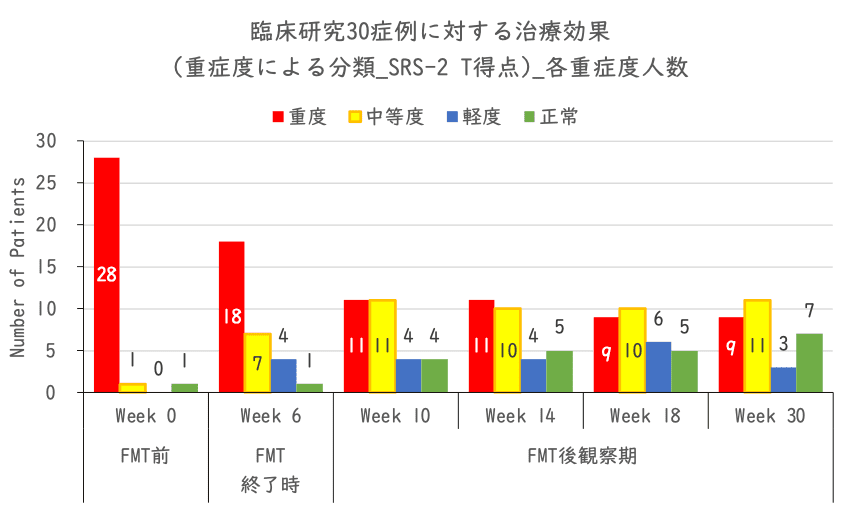
Expressing this result by the number of individuals across severity levels: out of 28 individuals in the severe range, 19 (approx. 68%), plus 1 individual in the moderate range—totaling 20 individuals (approx. 69%)—shifted to a milder range (which includes 6 individuals shifting to the normal range), demonstrating a substantial effect.
SRS-2 Total Raw Score
The above-mentioned mitigating effect on ASD severity showed different values depending on the presence or absence of gastrointestinal disorders in the subjects. Specifically, the mitigating effects on subjects with gastrointestinal disorders (n=22) and those without gastrointestinal disorders (n=8) were 24% (p=0.001) and 45% (P<0.001), respectively, both of which were statistically significant.
Presence or Absence of Gastrointestinal Disorders
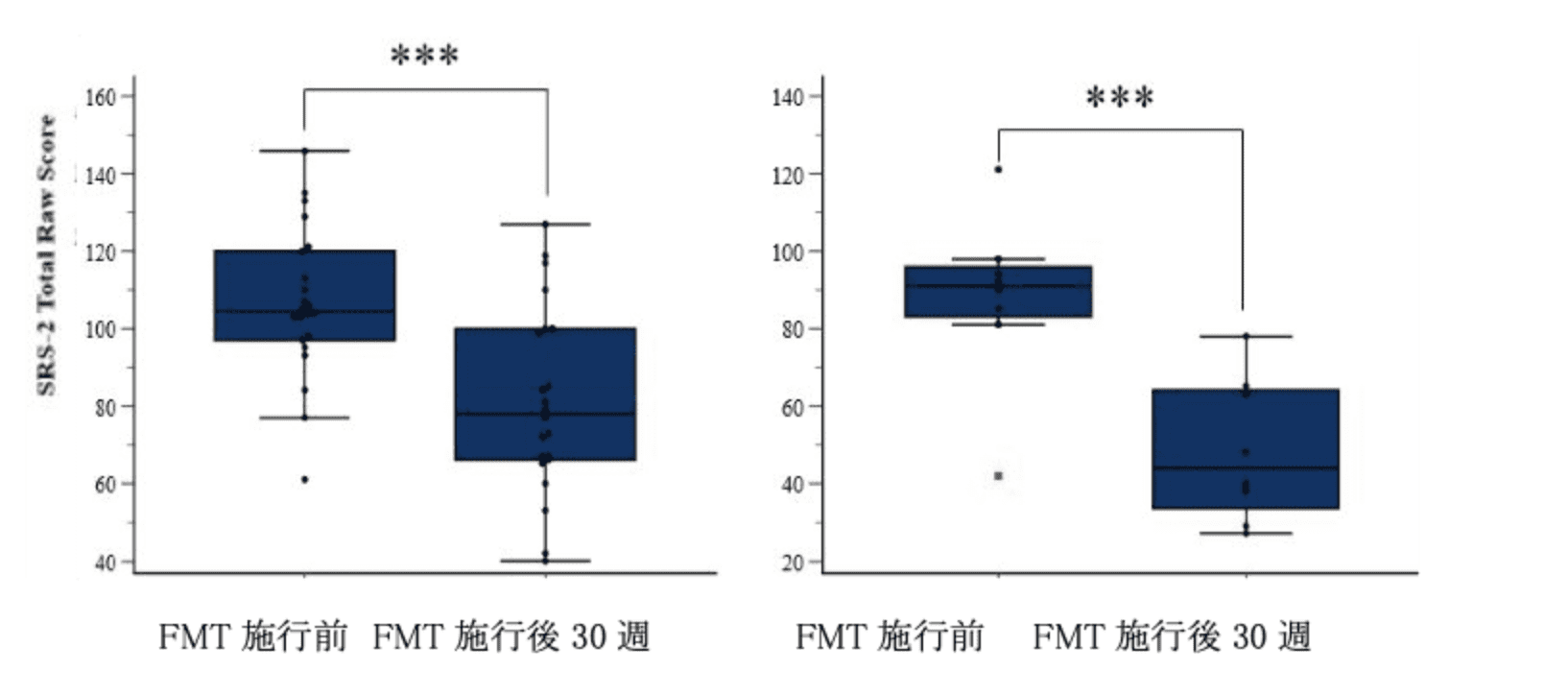
(Left figure) Box plot of SRS-2 scores for 22 subjects with gastrointestinal disorders. Paired T-test (Post-FMT vs Pre-FMT); ***p<<0.001.
(Right figure) Box plot of SRS-2 scores for 8 subjects without gastrointestinal disorders. Paired T-test (Post-FMT vs Pre-FMT); ***p<<0.001.
In the future, we plan to increase the sample size to solidify these results and consider the development of novel treatments for ASD.
② Subscales of SRS-2: SCI (Social Communication and Interaction) and RRB (Restricted Interests and Repetitive Behavior)
The novel FMT method statistically significantly reduced the severity of SCI and RRB by 28% and 33%, respectively (both P<0.001), showing values almost equivalent to the aforementioned mitigating effect on ASD severity.
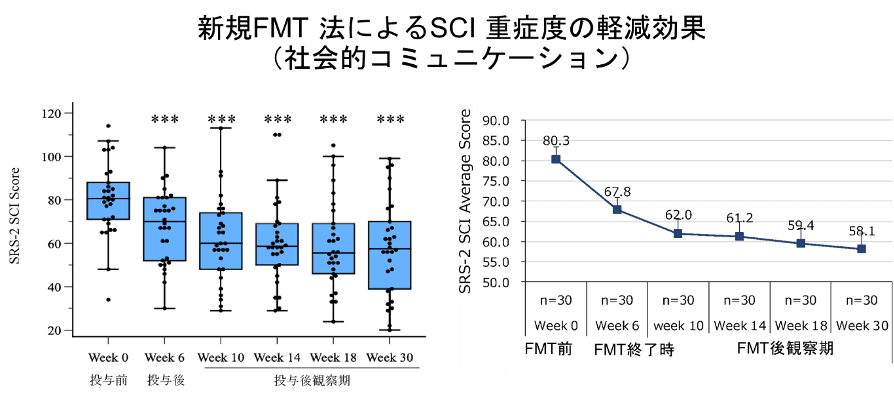
(Left figure) Box plot of SRS-2 SCI. Paired T-test or Wilcoxon signed-rank test (Post-FMT vs Pre-FMT); ***p<0.001.
(Right figure) Transition of the mean value of SCI. Each data point represents the mean ±S.E.M of n=30.
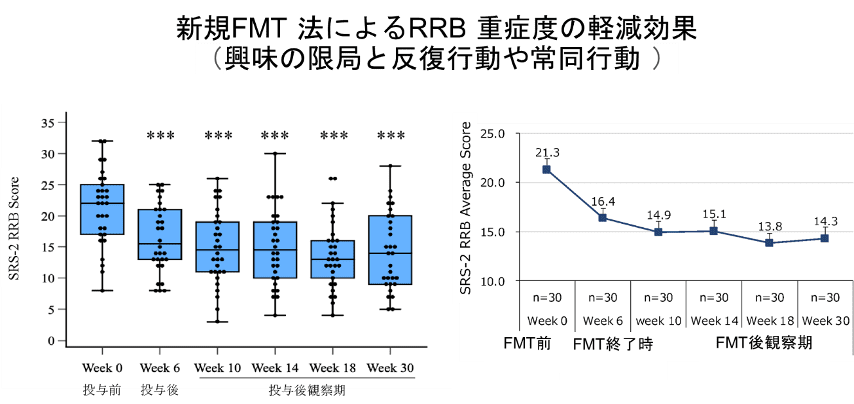
(Left figure) Box plot of SRS-2 RRB. Paired T-test (Post-FMT vs Pre-FMT); ***p<0.001.
(Right figure) Transition of the mean value of RRB. Each data point represents the mean ±S.E.M of n=30.
③ Subscales of SCI: Social Awareness (Awr), Social Cognition (Cog), Social Communication (Com), and Social Motivation (Mot)
At 30 weeks post-FMT, the reduction rates in the severity of the SCI subscales Awr, Cog, Com, and Mot were 24% (P<0.001), 25% (P<0.001), 27% (P<0.001), and 36% (P<0.001), respectively, all of which were statistically significant.
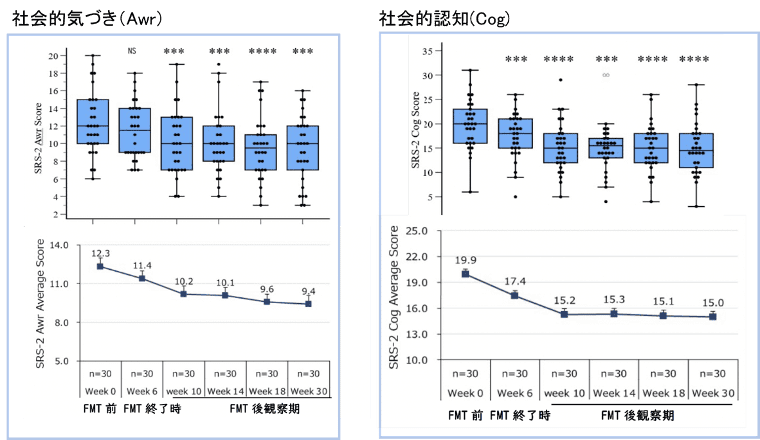
<Social Awareness (Awr):
(Top figure) Box plot of SRS-2 Awr. Paired T-test (Post-FMT vs Pre-FMT); ***p<0.001, ns: not significant.
(Bottom figure) Transition of the mean value of Awr. Each data point represents the mean ±S.E.M of n=30.
Social Cognition (Cog):
(Top figure) Box plot of SRS-2 Cog. Paired T-test or Wilcoxon signed-rank test (Post-FMT vs Pre-FMT); ***p<0.001.
(Bottom figure) Transition of the mean value of Cog. Each data point represents the mean ±S.E.M of n=30.
<
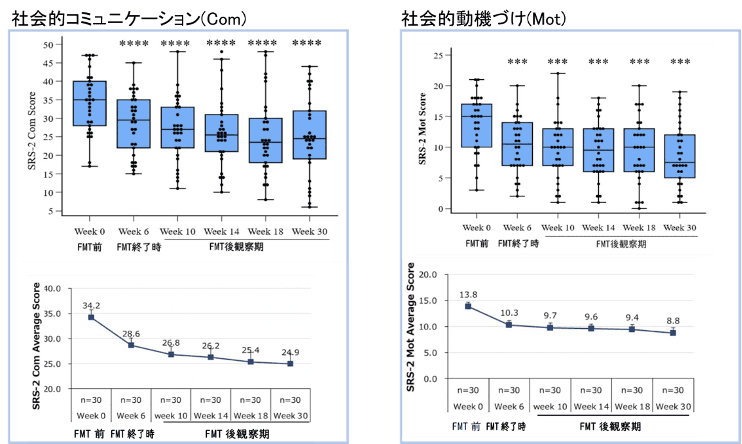
Social Communication (Com):
(Top figure) Box plot of SRS-2 Com. Paired T-test (Post-FMT vs Pre-FMT); ***p<<0.001.
(Bottom figure) Transition of the mean value of Com. Each data point represents the mean ±S.E.M of n=30.
Social Motivation (Mot):
(Top figure) Box plot of SRS-2 Mot. Paired T-test (Post-FMT vs Pre-FMT); ***p<<0.001.
(Bottom figure) Transition of the mean value of Mot. Each data point represents the mean ±S.E.M of n=30.
The above results indicated that the mitigating effect of the novel FMT method on ASD severity extended almost uniformly to the subscales SCI and RRB. Furthermore, the mitigating effect on SCI severity also extended almost uniformly to its four subscales.
Secondary Endpoints
① SSP (Short Sensory Profile)
Sensory processing disorder is an item included in RRB (Restricted Interests and Repetitive Behavior), which is one of the core symptoms of ASD.
Targeting 26 study subjects (approximately 87% of the total) in whom sensory processing disorder was recognized, the mitigating effect of the novel FMT method on the severity of sensory processing disorder was examined. As a result, a statistically significant reduction effect of approximately 30% (P<0.001) was observed.
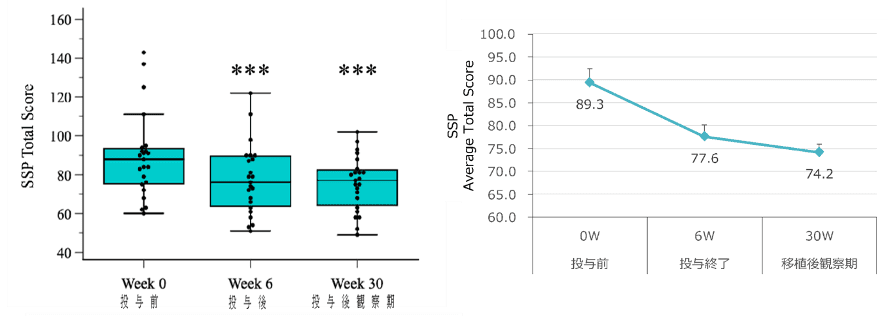
(Left figure) Box plot of SSP total score. Wilcoxon signed-rank test (Post-FMT vs Pre-FMT); ***p<<0.001.
(Right figure) Transition of the mean value of SSP total score. Each data point represents the mean ±S.E.M of n=23-26.
Furthermore, the mitigating effects on the severity of its subscales—Hypersensitivity, Hyposensitivity, and Sensation Seeking (Underresponsive/Seeks Sensation)—were statistically significant at approximately 28% (P<0.001), 23% (P<0.001), and 28% (p<0.001), respectively.
The above results indicate that the novel FMT method uniformly impacts sensory processing disorder (included in the core symptoms), as well as its subscales of hypersensitivity, hyposensitivity, and sensation seeking.
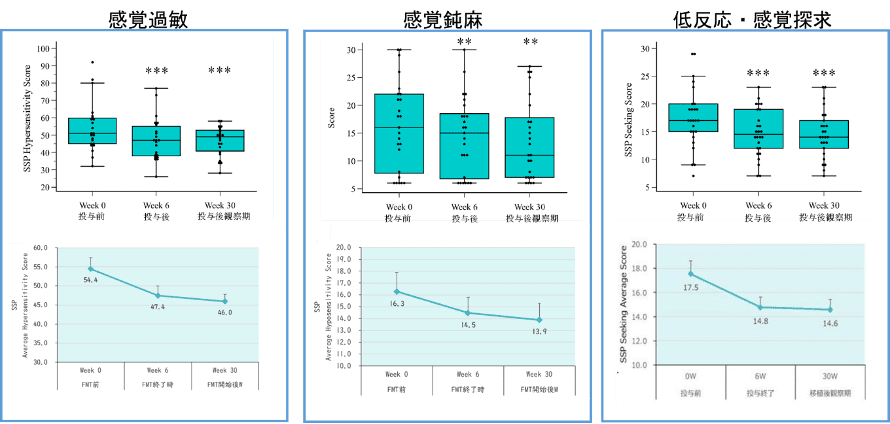
Hypersensitivity:
(Top figure) Box plot of SSP Hypersensitivity. Paired T-test or Wilcoxon signed-rank test (Post-FMT vs Pre-FMT); ***p<<0.001.
(Bottom figure) Transition of the mean value of SSP Hypersensitivity. Each data point represents the mean ±S.E.M of n=23-26.
Hyposensitivity:
(Top figure) Box plot of SSP Hyposensitivity. Paired T-test or Wilcoxon signed-rank test (Post-FMT vs Pre-FMT); p<<0.01.
(Bottom figure) Transition of the mean value of SSP Hyposensitivity. Each data point represents the mean ±S.E.M of n=23-26.
Low Responsiveness/Sensory Seeking (Seeking):
(Top figure) Box plot of SSP Seeking. Paired T-test or Wilcoxon signed-rank test (Post-FMT vs Pre-FMT); ***p<<0.001.
(Bottom figure) Transition of the mean value of SSP Seeking. Each data point represents the mean ±S.E.M of n=23-26.
②Gazefinder
SRS-2 is positioned as an objective assessment tool. In this study, to reconfirm that evaluations by SRS-2 do not introduce bias, the SRS-2 results were evaluated against the results of Gazefinder, which is “drawing attention as an objective testing method.” As a result, the severity of SCI (a major component of SRS-2 serving as a “measure of sociability”) showed a statistically significant positive correlation (r=0.474, P=0.01) with the “fixation time on geometric patterns” by Gazefinder, which “enables the evaluation of sociability.” Furthermore, it showed a statistically significant negative correlation (r=-0.414, p=0.03) with the “fixation time on human figures.”
This revealed that the results of SCI, which occupies a major position within the SRS-2, maintain objectivity.
③GSRS (Gastrointestinal Symptom Rating Scale)
Of the 30 study subjects, 22 (73.3% of the total) who presented with gastrointestinal disorders prior to FMT were included for evaluation.
As a result, the novel FMT method statistically significantly reduced the severity of gastrointestinal disorders, with a reduction rate of approximately 61% (p=0.001). The magnitude of this effect greatly exceeded the reduction rate of ASD severity.
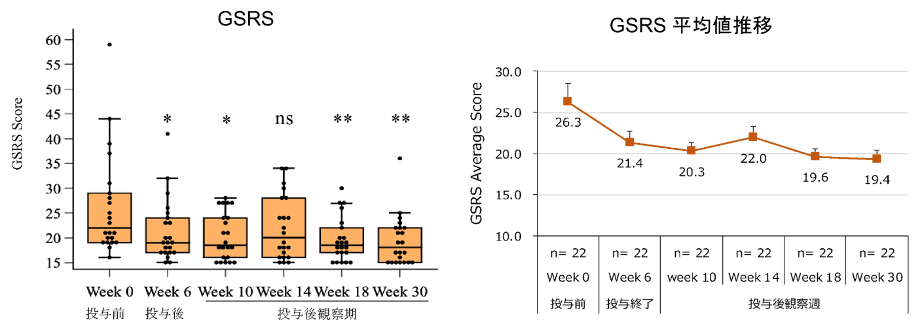
(Left figure) Box plot of GSRS total score. Wilcoxon signed-rank test (Post-FMT vs Pre-FMT); *p<<0.05, p<<0.01, NS: not significant.
(Right figure) Transition of the mean value of GSRS total score. Each data point represents the mean ±S.E.M of n=22.
④BS Scale (Bristol Stool Form Scale)
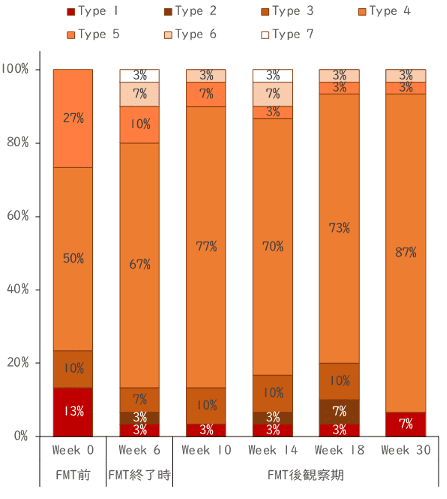
Prior to FMT, 60% of the study subjects passed type 3 and 4 stools, which are considered normal stools. Following FMT, type 4 stools (ideal stools) gradually increased, reaching 87% at 30 weeks post-FMT.
This result indicates that out of 12 subjects whose stool consistencies were outside the normal range, approximately 8 transitioned into the normal range, yielding an improvement rate of 67%. This value was similar to the improvement rate for gastrointestinal disorders (61%), further supporting the efficacy of the novel FMT for gastrointestinal symptoms.
⑤PHQ-4 (Patient Health Questionnaire-4)
Targeting 26 of the 30 study subjects who exhibited depressive and anxiety symptoms, the mitigating effects of the novel FMT method on these symptoms were evaluated using the PHQ-4 (which encompasses PHQ-2 and GAD-2).
i)PHQ-4
The novel FMT method showed a statistically significant mitigating effect on the severity of depression and anxiety. The reduction rate was approximately 50% (p<0.001), greatly exceeding the reduction rate of ASD severity measured by SRS-2 (approximately 29%).
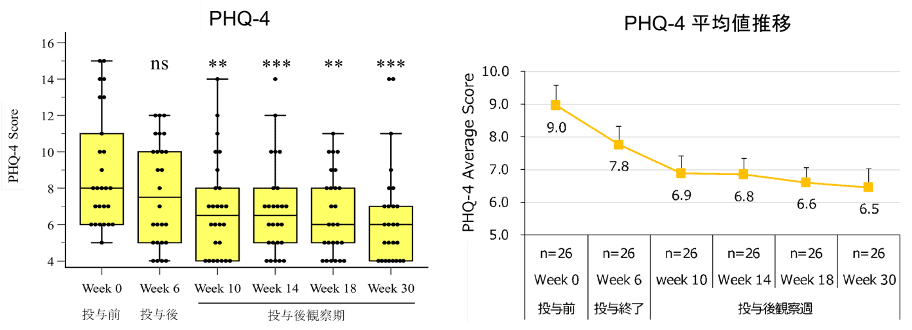
(Left figure) Box plot of PHQ-4 total score. Wilcoxon signed-rank test (Post-FMT vs Pre-FMT); p<<0.01, ***p<<0.001, ns: not significant.
(Right figure) Transition of the mean value of PHQ-4 total score. Each data point represents the mean ±S.E.M of n=26.
ii)PHQ-2
The novel FMT method showed a statistically significant mitigating effect on the severity of depressive symptoms. The reduction rate was 56% (P=0.001).
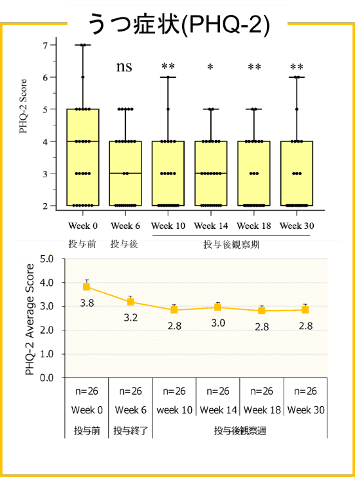
(Top figure) Box plot of PHQ-2 total score. Wilcoxon signed-rank test (Post-FMT vs Pre-FMT); *p<<0.05, p<<0.01, ns: not significant.
(Bottom figure) Transition of the mean value of PHQ-2 total score. Each data point represents the mean ±S.E.M of n=26.
iii)GAD-2
The novel FMT method showed a statistically significant mitigating effect on the severity of anxiety symptoms. The reduction rate was 50% (p< 0.001).
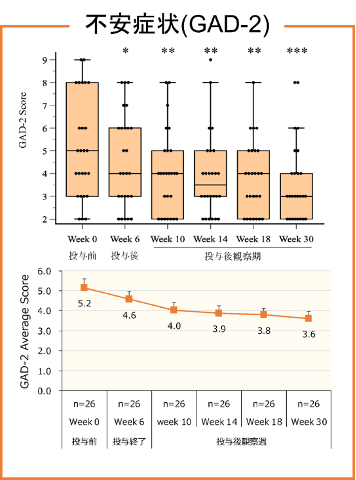
(Left figure) Box plot of GAD-2 total score. Wilcoxon signed-rank test (Post-FMT vs Pre-FMT); *p<<0.05, p<<0.01, ***p<<0.001.
(Right figure) Transition of the mean value of GAD-2 total score. Each data point represents the mean ±S.E.M of n=26.
Summarizing the above results, it has become clear that the effects of the novel FMT extend broadly across a wide range of ASD symptoms, as well as associated symptoms including gastrointestinal disorders, depression, and anxiety.
◾️7.要約
The effects of the novel FMT method on ASD symptoms were evaluated in 30 children with ASD using the SRS-2.
As a result, the severity in ASD children was statistically significantly reduced by approximately 29%. Expressing this result by the number of individuals across severity levels, it was found that 20 out of 30 individuals (approximately 69%) shifted to a milder range, including 6 who shifted to the normal range. The aforementioned effects differed depending on the presence or absence of gastrointestinal disorders in the subjects prior to FMT; the reduction effect was 25% for ASD children with gastrointestinal disorders, while it was a much greater 45% for ASD children without gastrointestinal disorders.
Furthermore, the effects of the novel FMT method broadly extended to a wide range of core symptoms of ASD, including sensory processing disorder, with a uniformly large effect size of approximately 30%.
Moreover, this effect widely extended to gastrointestinal disorders, depression, and anxiety—which are frequently comorbid in children with ASD—and its effect size for these was even larger at 50% to 61%.
Thus, it has been demonstrated that the effects of the novel FMT method broadly cover ASD and its associated symptoms, which possess diverse neural foundations. Its efficacy is highly anticipated for other neuropsychiatric disorders as well.
We share the results of specific clinical studies and the latest news from our research group via LINE. We encourage you to sign up.
その他の Clinical Study に関する記事
Articles about other Clinical Study

October 28, 2024
〈Clinical Trial〉Completion Report
We are pleased to report the completion of the specified clinical trial titled “Specified Clinical Trial on the Efficacy and Safety of a Novel Fecal Microbiota Transplantation Method for Autism Spectrum Disorder,” which was initiated by our research group in May 2023. This specified clinical trial is published on the jRCT (Japan Registry of Clinical […]

April 20, 2023
A clinical study of a new FMT method using hydrogen nanobubble water (NanoGAS® water) without antimicrobial agents has been initiated.
Clinical Study on the Efficacy and Safety of a Novel Fecal Microbiota Transplantation Method for Autism Spectrum Disorders A clinical study by physicians and others affiliated with our research group has been initiated. The study is available on the jRCT (Japanese Research Reporting and Clinical Trial Submission System) at https:// […].